--Stand up and walk: Thoughts on a church social justice committee--
Updated: Oct 11, 2026
My final master's course before I move onto my capstone project is called "Learning Through Struggle," which can truly only be explained as a professional SJW course. This is a reflection for one of the classes that I want to come back to and refine, so I'm planting it in my garden and posting it here.
The past couple of weeks, I've been thinking about two things:
The first is that moving people who are undisturbed feels like a Herculean challenge. Specifically, I'm thinking about the diagram of the slave ship Brooks in Rediker (2008), and its associated campaign. It's a great tale of iteration: the first version of the infographic argued that abolishing the slave trade would actually increase the worth people's slaves, but subsequent revisions moved the message more and more toward total abolition. But the image was key. It disturbed everyone who looked at it, and the accompanying paragraphs carried the case. Rediker talks about some white man lawmaker (someone who could be in the slave-owning class) struggling to describe the image of humans packed into a boat, simply pointing to it instead. That's pretty good evidence of how disturbing it was!

 Yikes. Image: William Elford,1788
Picking up on that point, my professor talked about a Palestinian photo book (please remind me what it is so I can link it in, Sara!). She said as she was flipping through it, that she felt "the case is made," by the images, people just need to see them. I'm not so sure... I've been haunted by what a classmate said about her high school English students: how they used to cry at disturbing texts, and how none of them cry anymore.
It seems that only certain things break through and only with certain people. I'm thinking about George Floyd and Renee Good: both extreme images (videos of people literally dying) that managed to be so deeply resonant that they sparked a fire. However, many other similar images and moments have gone by uncontested. So bearing witness matters, but it can't be a strategy in itself. You can't predict which image or moment will cause people to move. The only thing you can control is being ready to act when they are moved - that was the over-arching lesson from the three Minnesota Fight Back organizers interviewed on The Dig podcast.
I admit that I wasn't very aware of what was happening in Minnesota - I don't have in social media, I'm a passive consumer of the news (aka I cook with CBC Radio on), and I sure as hell don't consume American news. But it was interesting to learn that Minnesota's capacity to respond to ICE occupation came from decades of base building within and across faith-based, labour, and immigrant organizations. The podcast was also challenging - the Reverend Bates and the story of clergy in cuffs at the airport reminded me that this work must live in churches.
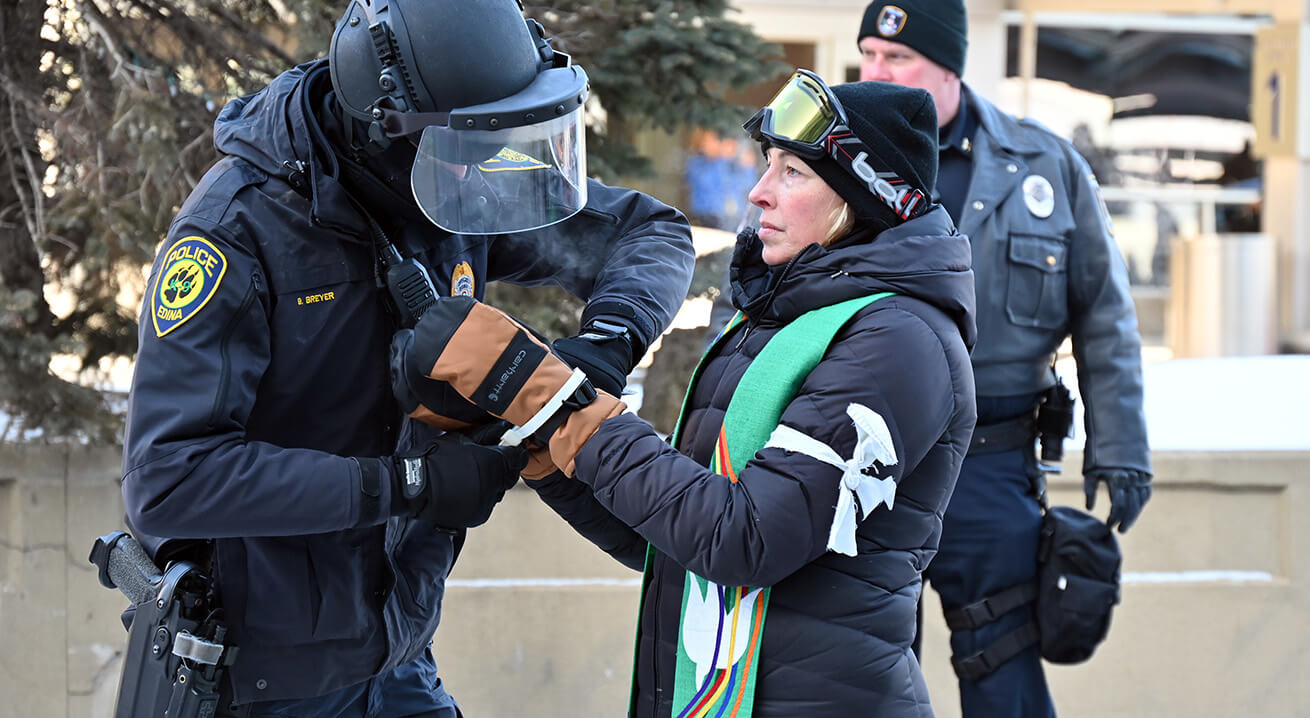 God bless ya, arrested Reverend! Photo: Jack Jenkins, 2026
That's where the rest of this goes. I find myself at the intersection of taking this class, thinking about church's role in social movements, and helping my church start up a social justice committee. This is a good opportunity to honestly reflect on what we're already doing, who we are, and how we might start with this new ministry in light of things learned.
Dearest Christ Church
I would not describe The Anglican Parish of Christ Church as particularly activist, though I would describe it as a lovely community. The Anglican tradition in Canada, especially on the prairies, is a lot more Church of England than Episcopalian. It's a broad tent of fence-sitters. We have a congregation of about 150 folks at Christ Church, and it's the kind of church where a doctor that works in gender-affirming care and a guy who writes for the right-wing Western Standard sit together in the pews. The tie that binds us (and sometimes feels like the only tie that binds us) is our faith and tradition.
We aren't radical (like, at all), but our website says that we take "seriously the call of the gospel to love our neighbours, to break bonds of oppression, and to thirst after justice and mercy for all" (Christ Church, 2026). Toward this aim we advocate, raise awareness, and provide mutual aid - things that can be in tension with activism and liberation, but are important work nonetheless.
 Christ Church, where gardening is our most popular ministry. Photo: Me, 2026
Most recently, the congregation was moved to write letters in opposition to a proposed expansion of Paul Kane Park that would reduce parking around the church (if you go to my church and were embarrassed to read this sentence... good). We've sponsored two refugee families from Syria over the past decade. We're also great cheque-cutters. The sermons at Christ Church are challenging, thought-provoking, and often moving. So moving that we are moved to drop money in the plate. We write the victims of conflict into our prayer cycle and all of the people say, "Lord, hear our prayer." We also do some charity. The church has a 40-plus-years-running monthly dinner for the wihkwentowin community. It is our largest community outreach ministry and is a source of immense joy and purpose for many in the congregation. We hold that mutual aid and caring for the poor are basic tenets of the faith.
But in John Chapter 5, Jesus also tells a helpless man who has lain paralyzed for 38 years to stand up and walk. That verse, to me, is a confessional version of Minnesota organizer Emilia Gonzalez Avalos' working theory: if you believe there's a pathway from service to power, it's not negotiable that there is leadership development and popular education along the way. As Emilia says, "we can't fundraise and food bank our way to freedom" - indeed, we also must support people to stand up and walk toward it.
The Committee, The Community
My working thesis about my church's social justice committee is two-fold: first that we should build power through the church (versus merely providing aid), and second, that the social justice committee should organize the congregation not just as a community in itself, but as part of the community to which it belongs.
Christ Church is situated in the heart of wihkwentowin, formerly Oliver, a neighbourhood just west of downtown Edmonton. It's one of the densest and most diverse communities in Edmonton, consisting of million-dollar-plus penthouses and low-income walk-ups. The congregation isn't totally representative of the community, with a large commuter contingent (hence all of the PJWs - parking justice warriors). People drive in mostly from "nice" west-end neighbourhoods. I moved out of wihkwentowin and into Crestwood just over a year ago and now count myself among this group.
I missed the inaugural meeting of the social justice committee, but I got a report that it was, as expected, a bit of a dog's breakfast featuring everyone's pet issue. The agenda for the next one is to decide what the organization of the committee will be. So the pressing question is: if we want to do this work as a church, where should we start? This isn't something that needs to be built from scratch, and I think the answer involves working on three levels: the congregation, the community, and the network. The thread running through all of them is collective discernment.
Collective Discernment as Tactic
Reading about the Redstockings' Abortion Speakout in 1969 (as analyzed by Dubriwny, 2005), two narrative tactics stood out to me. The first was the kernel story, where one woman started her story and others picked up a thread and added until it became, in essence, everyone's story. This reminds me of a type of prayer that I learned from someone who grew up in the Black Baptist tradition. She described folks standing in a circle, one person starting a prayer and others picking up threads and adding to it until it became a true "prayer of the people."
The other was how the audience were encouraged to become active participants in the panel as a way of gathering voices to build a collective account. Women were responding, adding to, and asking questions to what the panelists offered. To me this feels akin to the Mennonite tradition of zeugnis where after the sermon, the congregation has an opportunity to respond. For example, if so moved by the Spirit, someone might respond directly to the sermon, confess, sing a hymn, or offer a prayer. The point is to do "the work of discerning if and how the good news has been proclaimed in and among us" (Florer-Bixler, 2015) - a shift from clergy addressing believers to a priesthood consisting of all believers.
 A priesthood of everyday women. Image: Redstockings, 1969
Both of these tactics are demonstrated channels for community voices. Cristina Palabay, a human rights organizer in the Philippines, alludes to the specific importance of the discernment piece, proposing that running a focus group is easy to do, but real participation means people have to make sense of things and "claim these analyses as their own" (Choudry, 2015, p. 130). This is also the case with the Redstockings. The Speakout wasn't just women actively participating in the panel, they were making meaning of their own and other women's stories. The result was a frame shift from what society says it means to have an abortion to what women say it means to have had an abortion. I think this is what Avalos's popular education step could look like in our church: not teaching people about an issue, but producing an understanding together. The process must go beyond sharing. We should collectively and actively ask God for guidance, and then collectively and actively discern His response.
As a Community, Within a Community
These tactics can be employed over multiple levels of this work, and the first is building capacity within the congregation. The dog's breakfast of potential directions could be an inventory of what members already care about and what moves them. Through shared discernment, we can get from there to a committee purpose. One question I'd really like to ask the room is: "how many of you live in wihkwentowin?" I might be harping on this point, but I deeply believe that churches should be pillars of the communities they're in, and it's important to know who has that stake.
This bleeds into the second level which involves the broader community. Another organizer from the Philippines, Arnold Padilla, points out that effective organizing is impossible without social investigation, and that:
organizers must understand the community; identify relationships within that community, including people's class background and source of livelihood, because this guides them in their organizing work and in terms of whom to approach; and they must work out the most pressing issues impacting people and the issues that will mobilize them to action (Choudry, 2015, p. 135)
We reach out to wihkwentowin through our monthly dinners, but how do we help the folks who attend build power? Could this ministry be a vehicle through which we listen, help folks analyze their own data, and do real community church work led by the conclusions of folks who actually live here? Like Palabay saying that analysis and conclusion (and therefore direction) in a movement "cannot come from [the leaders and organizers], because we are from Manila," (Choudry, 2015, p.133) it can't come from us either - because we’re from Crestwood, Valleyview, Laurier Heights, Glenora, etc.
But even if we do all of the above well, we'd still be one church going it alone. And the Minnesotan lesson was that a lot of power comes from the solidarity and collaboration across organizations. So the third level is the network. A lot of organizing work in wihkwentowin has already been done, and we don’t need to reinvent the wheel. Thinking ecumenically about it, just down the street is a more activist United Church that we could really stand to talk to more. Another potential avenue for networking is our invitation to join the Greater Edmonton Alliance, an organization of faith and labour organizations based on the Industrial Areas Foundation (Alinsky) model.
So, where should we start?
I think we should start simply and thoughtfully. Let's not jump into a project. Let's pray about and discern where God wants our committee and our church to move. Let's talk to other churches who have been doing this base- and power-building work and establish ourselves as a node in their networks. Most importantly, let's discern what it means for our church to "do" social justice. Are we going to just serve the people of Christ Church and wihkwentowin, or be accountable to them, too? To do the latter, we're going to have to stand up and walk.